
AD
Modern contemporary design Singapore homeowners love is often confused with minimalist design — and understandably so. Both styles feature clean lines and decluttered spaces. But look closer and the differences matter for how your home feels, functions, and costs to create. This guide compares the two styles to help you choose what fits your Singapore home and lifestyle.
This guide is for informational purposes. Prices and regulations may change — always verify with HDB, BCA, or your interior designer.
Defining Modern Contemporary and Minimalist Design
Both styles emerged from the desire to simplify interiors, but they interpret simplicity differently. Understanding their origins helps clarify the distinction.
Modern Contemporary Design blends current trends with mid-20th century modern design principles. It features clean lines but allows for visual warmth, eclectic elements, and personality. Contemporary design is fluid — it evolves with changing tastes while maintaining a sophisticated foundation.
Minimalist Design is more prescribed. Rooted in Japanese and Scandinavian traditions, it reduces interiors to absolute essentials. "Less is more" is not just a preference but a philosophy. Every object must earn its place through function; decoration for its own sake has no role.
Aspect Modern Contemporary Minimalist
Core philosophy Curated variety, current sophistication Essential only, nothing excess
Colour approach Neutral base with accent colours Mostly monochromatic, white-heavy
Decorative objects Yes, thoughtfully selected Very few to none
Furniture style Mix of forms and materials Streamlined, uniform
Texture variety Multiple textures welcomed Minimal texture variation
Visual interest From objects, art, materials From space, light, proportions
Source: Interior design style definitions
For a detailed exploration of modern contemporary principles, see our guide to modern contemporary design for Singapore homes.
Visual Differences at a Glance
Walk into a modern contemporary home and a minimalist home — what would you notice differently?
Colour and Palette
Modern contemporary interiors use a neutral base (warm whites, greys, beiges) but introduce colour through accent furniture, artwork, soft furnishings, and feature walls. A deep teal accent chair, rust-coloured cushions, or a bold artwork are all welcome.
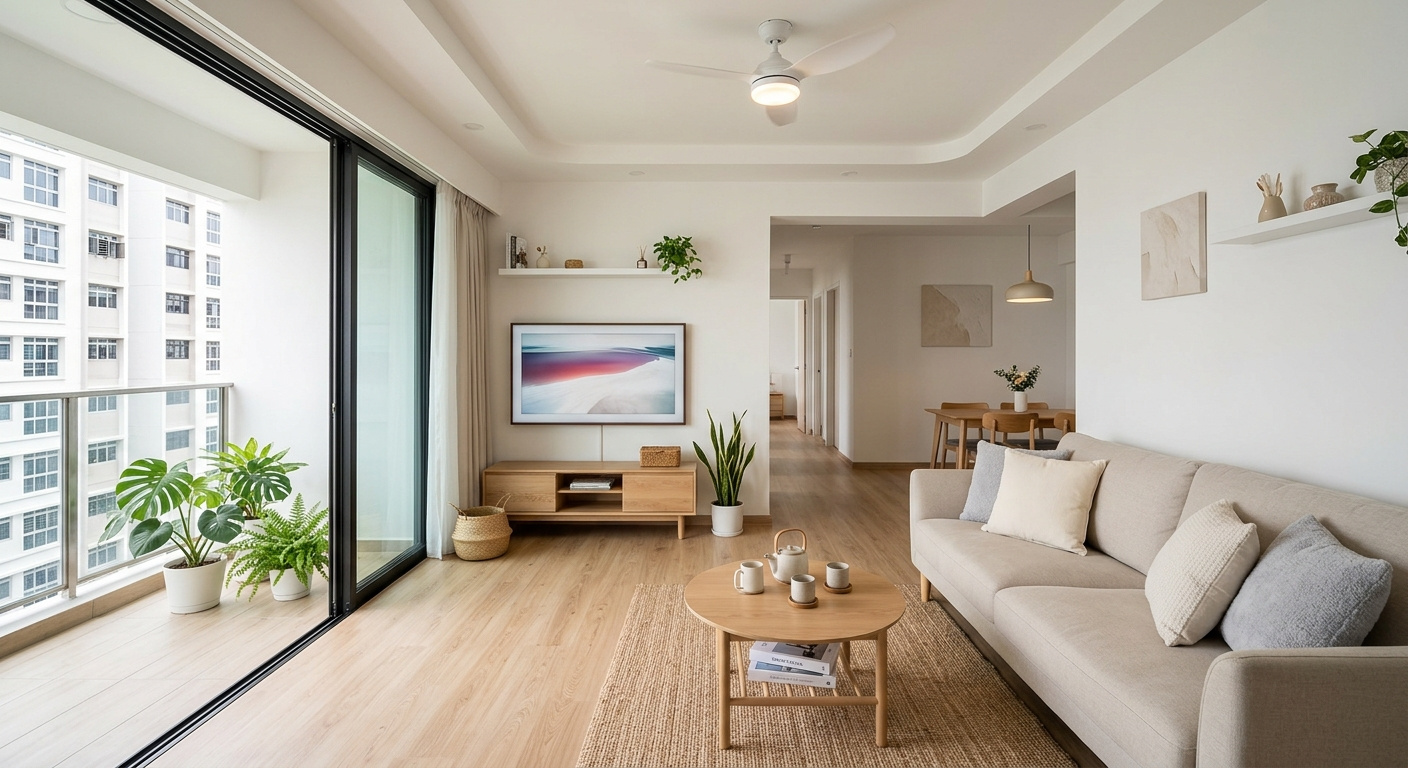
Minimalist interiors stay within a tight palette. White, off-white, light grey, and pale wood dominate. If colour appears, it is muted and purposeful — perhaps one vase in a soft terracotta or a single plant adding green. Anything that draws too much attention is considered noise.
Furniture and Objects
Modern contemporary rooms feature furniture of varying styles, provided they share a level of quality and sophistication. A curved velvet sofa might sit with a sleek metal side table and a natural wood coffee table. The combination creates visual interest.
Minimalist rooms select furniture for pure function with identical design language throughout. All pieces share similar lines, materials, and proportions. Visual quiet matters more than variety.
Walls and Surfaces
Modern contemporary design embraces feature walls: fluted panels, textured paint, stone cladding, or decorative wallpaper in key areas. Art and mirrors appear on walls. Shelving may display curated objects.
Minimalist walls stay mostly bare. Any texturing is subtle and uniform. Art, if present, tends toward simple, large-scale abstracts or monochromatic photography. Nothing clutters the visual field.
Lighting
Modern contemporary interiors feature statement lighting: a sculptural pendant over the dining table, a designer floor lamp by the sofa, decorative wall sconces. Lighting is both functional and decorative.
Minimalist lighting disappears into the architecture. Recessed ceiling lights, linear LED strips, and simple fixtures maintain illumination without becoming focal points. The goal is even, ambient light rather than drama.
Practical Implications for Singapore Homes
Both styles work well in Singapore's high-rise living context. However, they suit different home types, family situations, and maintenance preferences.
Space Perception
Minimalist design makes small spaces feel larger. The absence of visual clutter, consistent palette, and open surfaces create an expansive impression. For compact 3-room HDB flats, minimalism maximises perceived space.
Modern contemporary can feel busier in very small spaces but brings warmth and personality that some find minimalist spaces lack. It works particularly well in 4–5 room flats and condos where there is room for varied elements.
Family Considerations
Families with children often find minimalist design challenging to maintain. Children's belongings, toys, and artwork resist the spare aesthetic. Constant editing becomes a daily battle.
Modern contemporary absorbs family life more easily. A children's drawing can join the gallery wall; colourful toys become part of the eclectic mix. The style accommodates reality rather than demanding perfection.
Storage Solutions
Both styles rely heavily on concealed storage to hide clutter. This means investing in built-in carpentry: full-height wardrobes, TV consoles with enclosed compartments, kitchen cabinets that conceal appliances.
Storage Element Modern Contemporary Approach Minimalist Approach
Open shelving Yes, with curated display items Rarely, or completely empty
Display cabinets Welcome, with varied objects Avoided
Countertop items Few well-chosen objects Almost nothing visible
Visible books Part of the aesthetic Stored away
Artwork storage Rotated, with some displayed Minimal ownership
Source: Storage philosophies by design style
Humidity and Maintenance
Singapore's humidity affects both styles. Minimalist's white-heavy palette shows every dust particle and requires frequent cleaning. Any aging or discolouration is immediately obvious.
Modern contemporary's varied colours and textures are more forgiving. Natural materials may show patina, but this can add character rather than appearing neglected. Maintenance still matters but feels less critical.
Cost Comparison
Modern contemporary typically costs more than minimalist for the same space because it involves more design elements, varied materials, and statement pieces.
Cost Category Modern Contemporary Minimalist Difference
Design fees Higher (more complexity) Standard +10–15%
Feature walls Multiple, varied materials Minimal or single +15–25%
Furniture Varied brands and styles Consistent, streamlined +5–10%
Decorative objects Curated collection Very few purchases +20–30%
Lighting Statement fixtures Recessed and simple +15–25%
Overall 4-room HDB SGD 65,000–90,000 SGD 55,000–75,000 +15–20%
Source: Comparative renovation budgets, Singapore 2026
However, minimalist design requires exceptional carpentry precision because every imperfection shows. There is nowhere to hide a misaligned drawer or uneven surface. This can push carpentry costs higher than standard finishes.
Where Minimalist Costs More
High-quality white laminate or spray-painted finishes (SGD 700–1,200 per running metre versus SGD 400–600 for standard laminate). Premium hardware with concealed or invisible mechanisms. Flawless ceiling and wall finishes with no texture to mask imperfections.
Where Modern Contemporary Costs More
Multiple feature wall treatments (stone, fluted panels, wallpaper) throughout the home. Statement furniture pieces from designer brands. Varied pendant lights, decorative fixtures, and layered lighting schemes. Artwork and decor purchases.
For baseline renovation costs across all styles, see our HDB renovation cost guide.
Living with Each Style
Beyond construction, consider how each style affects daily life.
Morning Routine
In a minimalist home, you wake to serene blankness. Everything has its place; the bedroom is a sanctuary of calm. Getting ready involves moving through uncluttered spaces with a clear mind.
In a modern contemporary home, you wake surrounded by character. The artwork on the wall, the textured throw on the bed, the unique bedside lamp all affirm your taste and create visual interest that greets the day.
Hosting Guests
Modern contemporary homes feel warmer for entertaining. Conversation pieces abound: "Where did you get that lamp?" "This artwork is beautiful." Guests feel comfortable amid the curated abundance.
Minimalist homes can feel formal for guests unfamiliar with the aesthetic. Some visitors worry about touching things or disrupting the precise arrangement. However, those who appreciate minimalism find these spaces deeply restful.
Long-Term Living
Minimalist spaces demand discipline. Every acquisition must be considered: do I need this? Does it serve a function? Where will it live? This ongoing curation can feel liberating or exhausting depending on personality.
Modern contemporary offers more flexibility. Your tastes can evolve, pieces can be added or changed, trends can be incorporated. The style grows with you rather than requiring constant editing.
Which Style Suits You Best
Consider these questions to determine your natural alignment:
Question Modern Contemporary Answer Minimalist Answer
"I feel calm in..." Warm, layered spaces with personality Spare, quiet spaces with nothing excess
"Collections are..." A curated expression of who I am Clutter I prefer not to have
"White walls make me feel..." Like something is missing Peaceful and expansive
"Statement furniture..." Is essential for character Competes for attention
"My ideal living room has..." Books, art, varied textures A sofa, a table, beautiful light
"I shop for home items..." Regularly, finding special pieces Rarely, only replacing broken items
Source: Design preference assessment framework
There is no wrong answer. Both styles create beautiful homes when executed thoughtfully. The question is which matches how you naturally live and what brings you joy in your space.
The Hybrid Approach
Many Singapore homeowners land between these poles. This "warm minimalist" or "restrained contemporary" approach maintains minimalist bones — clean lines, concealed storage, neutral palette — while allowing for selective warmth: a textured rug, statement lighting, or a single vignette of meaningful objects.
This hybrid works particularly well for couples with different preferences or homeowners who appreciate minimalist principles but cannot commit to the full discipline.
Explore both styles and more in our interior design gallery to see how Singapore homes interpret these aesthetics.
Frequently Asked Questions About Modern Contemporary Design Singapore
What is modern contemporary interior design?
Modern contemporary interior design blends current trends with mid-century modern principles. It features clean lines, sophisticated neutrals, and curated objects that add warmth and personality. Unlike minimalism, it welcomes visual interest through varied materials, accent colours, and decorative elements while maintaining overall elegance.
Is modern the same as contemporary in interior design?
No. "Modern" specifically refers to mid-20th century design (1920s–1970s) with defined characteristics: exposed structures, organic forms, and specific materials like moulded plywood. "Contemporary" means current styles. However, "modern contemporary" combines elements of both, using modern design principles in current contexts.
Which style is better for small HDB flats?
Pure minimalist design typically makes small spaces feel larger due to its uncluttered aesthetic and light colours. However, modern contemporary works well if carefully edited. The key is choosing the style you will actually maintain — a cluttered minimalist space feels worse than a well-curated contemporary one.
Is minimalist design cold and unwelcoming?
It can be if executed without attention to warmth. Thoughtful minimalism incorporates tactile materials (wood, wool, linen), warm lighting, and comfortable furniture. Cold minimalism often results from focusing only on visual reduction without considering how the space feels.
What is modern contemporary interior design HDB style?
Modern contemporary interior design HDB style adapts the aesthetic to Singapore's public housing context. It balances visual interest with practical needs: concealed storage for small spaces, durable materials for humid conditions, and design choices that work within HDB renovation guidelines and budget constraints.
Can I mix minimalist and modern contemporary?
Yes, many homes successfully blend both. Use minimalist principles for architecture (clean walls, concealed storage, recessed lighting) while allowing modern contemporary warmth in furniture, textiles, and decor. The key is consistency: decide which rooms go which way, rather than mixing randomly.
Which style has better resale value?
Both styles appeal to Singapore buyers when executed well. Modern contemporary may have slightly broader appeal because it photographs well and feels lived-in. Minimalist design appeals strongly to a specific demographic but may feel too cold for others. Quality of execution matters more than style choice.
How do I prevent modern contemporary from looking cluttered?
Edit constantly. Limit decorative objects per surface. Ensure everything serves a purpose or brings genuine joy. Use the "one in, one out" rule for acquisitions. Keep negative space on surfaces. The goal is curated, not crammed.


Why Singapore’s Newly Completed Condos Are Quietly Making Owners Hundreds of Thousands in Profit
It’s been said that the past five years have changed Singapore’s property market more dramatically than the two decades before. And perhaps that’s true — Covid-19, supply bottlenecks, and shifting buyer priorities have turned old “rules” upside down.For example, small units once thought to be investor-only are now occupied by young professionals, while prime central homes — once the domain of wealthy foreigners — are being snapped up by local families seeking prestige and convenience. Amid all t

Why I Swapped My 40-Year-Old Jurong Flat for a Newer Bukit Panjang HDB: A Homeowner’s Journey
For many HDB owners, the decision to sell a long-held flat is never simple. Lease decay, mortgage planning, and future legacy considerations can make the process daunting. This case study explores how one homeowner, a 47-year-old finance professional living with her son, successfully transitioned from her 40-year-old Jurong East flat to a newer Bukit Panjang 5-room HDB, balancing current needs and long-term planning.Assessing the Need for a MoveBy late 2024, the homeowner fully owned her 5-room

The Hidden HDB Terraces You Never Knew Existed in Queenstown From Just $1.5M
If you love the charm of a landed home but not the sky-high prices that usually come with it, you might be surprised to learn that Queenstown offers an alternative — and at a fraction of the cost. Tucked discreetly within one of Singapore’s most mature towns are rare HDB terrace houses that let you enjoy the landed lifestyle without a multimillion-dollar price tag.A while ago, we featured Queenstown’s private landed homes that can go up to $12 million. Beautiful, yes — but hardly within reach fo

Dual-Key Condo Units in Singapore: Are They Worth It for Buyers?
Dual-key condominium units have been a fascinating segment of Singapore’s property market in recent years. Designed with two separate entrances and layouts under a single title, these units promise versatility—appealing to multi-generational families, investors seeking rental flexibility, or homeowners wanting privacy within the same property.Yet, despite the concept’s appeal, dual-key units have often drawn mixed attention at new launches. Their unique layouts, combined with generally higher qu

Your 2026 Guide to Buying an Executive Condominium (EC) in Singapore
Executive Condominiums (ECs) continue to be one of Singapore’s most attractive housing options, especially for buyers who want the perks of condo-style living at a more accessible price point. As we move through 2026, interest in ECs remains strong, boosted by steady demand from HDB upgraders and the limited supply of new launches each year.In recent years, EC projects have consistently performed well at launch. Lumina Grand EC, for instance, achieved impressive sales shortly after its release,

Coastal Cabana EC Set to Stir the Market: A Rare Pasir Ris Launch with Strong Family Appeal
For the first time in more than ten years, Pasir Ris is welcoming a brand-new Executive Condominium (EC) — and it is already generating strong interest among homebuyers looking for a lifestyle-centric address in the East. The project, now officially known as Coastal Cabana, arrives at a time when EC launches have been limited, especially in established neighbourhoods with a close-knit community feel.

I bought a freehold property in Singapore and regret it - here's the big mistake I made
Many Singaporean homebuyers, especially from older generations, have traditionally favoured freehold properties. The appeal is clear: a sense of permanence, the idea that their children or grandchildren will benefit from the investment, and years of advice reinforcing that freehold trumps leasehold. However, recent experiences from homeowners reveal that paying a freehold premium doesn’t always guarantee higher returns.A freehold property that didn’t outperformTY and her husband purchased their

HDB Support for Young Couples Buying Their First Home in 2026—What You Need to Know
Buying a first home as a couple is a huge milestone. It’s about creating your shared future, setting up your own space, and laying the foundation for family life. But in Singapore, it often feels like a daunting financial challenge. Between wedding costs, early-career salaries, and renovation expenses, many young couples wonder if homeownership is even possible when they’re just starting out.

The Hidden Costs of Buying a Home in Singapore (And How to Plan for Them in 2026)
When shopping for a new home, most buyers focus almost entirely on the property’s price tag. But in Singapore, the actual cost of homeownership goes far beyond the purchase price. From stamp duties to renovation works, legal fees to maintenance charges, these additional costs can add tens or even hundreds of thousands of dollars to your overall budget.Failing to account for these expenses often leads to unpleasant surprises. To help you plan better, here’s a comprehensive breakdown of the hidden

Do Primary Schools Really Drive Condo Prices in Singapore? These 6 Projects Say Not Always
When purchasing property in Singapore, many buyers and investors often prioritise proximity to primary schools. Even if they have no children or are not planning to enrol them yet, the prevailing belief is that condos near reputable schools enjoy better resale and rental prospects. But is this always true? Must a project without a nearby primary school struggle to perform? And if you personally don’t need schools nearby, is it safe to disregard this criterion?Interestingly, some condos have main

Are Singapore’s Oldest HDB Flats Losing Value? A 2026 Update
Singapore’s Housing & Development Board (HDB) flats have long been a stable part of the property market, but the question on many minds is whether the oldest units are finally starting to lose value. After all, these flats aren’t getting any younger, the SERS program has mostly concluded, and the VERS initiative looms on the horizon.Back in 2018, the government made waves by pointing out that even flats over 50 years old could still appreciate. Fast forward to 2026, and it’s worth revisiting the

The 2026 Guide to Affordable Housing in Malaysia: What You Need to Know
Even as Malaysia moves deeper into 2026, affordable housing remains one of the country’s most pressing challenges. For many young professionals, newly married couples, and middle-income families, the dream of owning a home feels increasingly out of reach. Despite some signs of price stabilisation, the gap between income levels and property prices—particularly in urban centres—continues to grow.In response, the Malaysian government has stepped up its efforts under the MADANI Economy framework and


