
Anúncio
Soundproofing a room involves more than just treating walls. Doors, windows, gaps, and even electrical outlets can undermine the results. Here's what to expect in terms of cost and what to consider before starting the work.
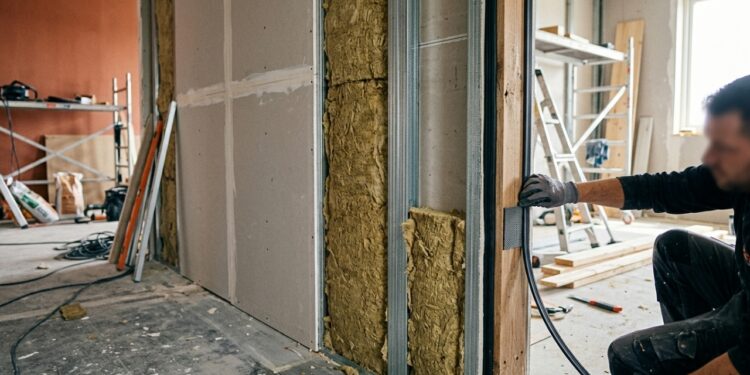
Cost references for a 12 m² room
A targeted intervention on a single wall may cost between R2,000andR2,000andR 6,000. This makes sense when the diagnosis identifies a predominant surface in the transmission path.
When walls, ceiling, windows, and gaps need to be treated together, the reference rises to approximately R8,000toR8,000toR 25,000, depending on materials and complexity.
Type of intervention | Estimated cost range |
Single wall treatment | R2,000–R2,000–R 6,000 |
Complete room treatment | R8,000–R8,000–R 25,000 |
Per square metre (not simply multiplied by floor area) | R75–R75–R 420/m² |
What needs to be included in the diagnosis
Noise can pass directly through a partition or bypass treatment through neighbouring elements. Discovering the dominant path comes before selecting materials.
Key points to analyse:
Partition walls shared with other rooms or units
Ceiling and slab connected to neighbouring structures
Door — including leaf, frame, and gaps
Window — especially if noise comes from outside
Electrical outlets and junction boxes installed in partitions
Pipe penetrations without proper sealing
Vents and ventilation that still need to function
Joints between walls, floor, and ceiling that can transmit vibration
Why doors and windows can limit the result
A reinforced wall offers little benefit if a lightweight door with large gaps remains in place. Sound tends to take the path of least resistance.
Windows also require analysis of glass, frame, sealing, and installation. Replacing only one part without considering the whole system can leave vulnerable points.
Does acoustic foam block neighbour noise?
Not necessarily. Foam primarily helps reduce reflections and reverberation within the room itself. Soundproofing between rooms depends on mass, structural separation, and sealing.
Gaps, installation passages, and ceiling paths can also compromise the result. Walls and ceilings need to be treated as part of a complete system, without compromising necessary ventilation.
Can a single wall treatment be enough?
It can — when the diagnosis identifies a dominant path, such as a lightweight partition between two rooms. In this scenario, treating only that surface can produce noticeable improvement.
However, if noise arrives simultaneously through the window, ceiling, and door, investing the entire budget in one wall will likely leave clear limitations.
What to check before you start
Before hiring a contractor, compare proposals that indicate exactly which surfaces and paths will be treated. Budgets based solely on floor area can hide important differences between quite distinct acoustic solutions.
Key takeaway
Soundproofing a room is a system — not just a single wall. Effective results depend on addressing all weak points: walls, ceiling, doors, windows, gaps, and even electrical outlets. A well-planned approach, based on a thorough diagnosis, will deliver better value for your investment.


Errar a ordem da reforma pode custar caro; veja como evitar

Azulejos velhos? Veja como modernizar o ambiente sem obra e sem sujeira
Cobrir azulejos sem quebrar nada vira tendência e promete renovar a casa com rapidez e economia.Modernizar cozinha ou banheiro já não significa enfrentar dias de barulho, poeira e entulho espalhado pela casa. Uma alternativa prática vem ganhando espaço no Brasil: aplicar novos acabamentos diretamente sobre os azulejos antigos. A proposta é simples — transformar o visual do ambiente sem recorrer à reforma tradicional.Com o avanço de materiais como massa acrílica niveladora e revestimentos sobrepo

Casa de 48 m² com piso aquecido passivo garante conforto descalço o ano todo

Quanto custa refazer o encanamento do banheiro em 2026? Veja preços e o que surge após quebrar o piso

Quanto custa transformar uma fachada comum em uma fachada moderna em 2026

Reforma em 2026: quanto custa o porcelanato e por que o contrapiso é a sua maior preocupação

Promessa de orçamento baixo para rodapé pode esconder surpresa: cantos tortos e recortes elevam custo em até 5 vezes

Drywall para dividir cômodos em 2026: o que encarece (e o que barateia) a conta final

Caução, fiador ou seguro-fiança: qual garantia de aluguel pesa menos no bolso do inquilino?
Garantias locatícias podem transformar a aprovação de um aluguel simples em uma etapa cara ou demorada. Caução exige dinheiro disponível, fiador depende da análise de terceiros e seguro-fiança gera pagamento periódico. A escolha afeta o custo inicial, a responsabilidade pela dívida e o encerramento do contrato.Quais garantias podem ser exigidas no contrato de aluguel?A Lei do Inquilinato permite caução, fiança, seguro-fiança e cessão fiduciária de quotas de fundo de investimento. Na locação resi

Vai comprar imóvel em leilão? Veja os sinais de alerta que podem evitar grandes prejuízos

Leilão de apartamento: veja como checar dívidas de condomínio e IPTU antes de comprar

Novo projeto residencial aposta em drywall com lã de rocha para reduzir ruídos e melhorar o conforto


